Saturday, November 21, 2009

Forgotten Trials of Liberty & Peace

Here is another post regarding MG Price's last effort to secure Missouri not just in the hearts of its citizens, but also militarily, for the Confederacy. Since I've discussed both Fort Davidson (Pilot Knob) and now the Battle of Westport, I think I'd like to share a few more words from LT John A Bennett of Co. D.

I often think of this time of year, and what the 8th MO CAV REG might have been doing on this day, so many years ago. From Bennett's diary from Campaigning With Marmaduke by James McGhee, we can gain a glimpse of the thoughts and hardships of the day. Without further adieu, here are some of his entries during that last great campaign of the fighting men of the Confederacy from Missouri, Arkansas and Texas - to free their home state and protect their neighboring states - from the tyranny of an invading and rest their homelands to liberty and peace - indeed their goal was a 'glorious victory' to this end.

31 OCT - "...The road runs part of the time in Arkansas and part in Cherokee Nation. Country passed over today nearly deserted. The houses are mostly burned and farms destroyed. The whole of the country traveled over from Jackson County, MO., to this point is deserted or nearly so. Towns burned, houses burned, and everything going to decay. The heart of the philanthropist can not help bleeding as he sees the destruction along this line of march and the misery it has caused thousands who once lived here in affluence and ease, but are now wanderers in exile from their once happy homes. God of mercy, stop this unholy war and let peace once more reign in the unfortunate country, is my prayer."

3 NOV - "Snow last night; quite gloomy this morning. Some snow throughout the day."

5 NOV - "Marched southeast; beautiful day. Camped in Cherokee Nation; very hungry at the time of writing this and no prospect of anything to eat. We have had no breadstuffs issued to us for two weeks past, living on broiled beef."

10 NOV - "My horse gave out yesterday about 12 o'clock, so I left him and had to foot it...we could travel much faster afoot than the command, as they had to stop and graze their animals to try to get them through, but hundreds are giving out every day and are left on the prairie. We have had no corn or forage of any sort to feed our animals for several hundred miles. The men have had no bread issued to them for 18 days and a hundred miles to march yet before we can get forage for horses or bread for men. The army is living on beef without salt..."

13 NOV - Morning beautiful and serene. Nothing to eat last night or this morning; very weak and loath to move on, but we are here in the wilderness and no one living nearer than 50 miles; all the settlements evacuated, therefore we are compelled to travel or starve. Six wagons met us this evening from Boggy Depot with rations of salt and flour. The ration was very short - only half a pint of flour to the man and about a thimble full of salt."

20 NOV - Cool, ground frozen; crossed a small stream early, below a mill; pulled of my boots and waded across; the cold water and rocks made my feet very cold...."

25 DEC - "Marched up the Red River 10 miles and camped at the winter quarters used by Gen. Gano's command last winter. This Christmas makes four that I have spent in the Confederate service. The Christmas of '61 I spent in camp near New Madrid; the Christmas of '62 I was on the Van Buren scout and made my dinner on a cold piece of cornbread; the Christmas of '63 I spent in Camp Ewing, Ark.; my dinner that day was something better than before - I had chicken, flour bread cooked on a board and beef roasted over the fire. What another year may bring forth is hard to tell. Where I am another Christmas, and what I may have for dinner, is too far in the future and the times too fluctuating to say what and where. I hope peace may be made before another year rolls around. That the soldiers of the Confederacy may return to their families and friends and enjoy once more the sweets of social society is my prayer."

31 DEC - "...Today closes the year 1864, and still the great war, commenced in 1861 is raging in all its savage fury. In 1860 we had peace at home and peace abroad. All things seemed to be in a prosperous condition....All things calculated to make man prosperous and happy were approximately to perfection. But lo, the contrast today! The despoiler came and in his ambition has brought ruin and desolation on our once happy country....We were once happy and resting quietly beneath our own vines and fig trees in peace; but now we are engaged in one of the most frightful wars recorded in the annals of time. Oh, that some person could come forth and set out a plan that an honorable peace could be ratified between the contending parties. Such a person's name would be honored to the latest generation. But we must look higher than man to see this war closed. We must look to Him who can calm the billows of the tempest-tossed ocean to bring peace and quiet to our country. When He has chastened the country for its neglect of duty, and not till then, will we have peace."

I don't think I can add much to his words that described his feelings and events of the day. The reality of war and the often deprivations of that of a soldier...even a cavalry soldier. God Bless all those that have, do and will sacrifice for freedom, peace and prosperity - especially that among this choice Nation of United States!!


Friday, November 20, 2009

Battle of Westport-CSA's Last Gasp in MO

Due to my new assignment in the US Army (Executive Officer...a position normally held by experienced 1st Lieutenant, not a brand new 2LT!...rough sledding here at first) I've been too busy to put up a post. I've been wanting to, but I'm a bit behind the time frame of one a month per new post.

Well, I'll pick up where I left off....discussing the last major attack into Federally held Missouri during the War of Southern Independence -"Price's Raid" to liberate Missouri from the invading host.

In the previous post, you will see the major engagements of the actions taken. Just click on that hyperlink to learn a little more of these mostly forgotten battles. I'd like to delve a little more specifically on the Battle of Westport, which occurred on 23 OCT 1864.

Gen. Joe Shelby and His Men at Westport

The above print is by the outstanding artist, Andy Thomas. He has a lot of great artwork depicting the Trans-Mississippi Theater. I really appreciate his efforts to tell more of the story of the fighting men on both sides of the conflict in these battles so many years ago.

Westport, which is on the south side of the modern day Kansas City, MO was really the last gasp of MG Price's Army of Missouri on that fateful expedition. Some call this the Gettysburg of the West (I'm not sure why...maybe in a small sense it is similar, but those comparisons don't speak of the larger mission objectives I believe). But to be sure it is one of the largest battles fought in Missouri with over 30,000 men engaged. Someone made a very comprehensive description (at least from the point of view that a blog should take!) of the Battle on Wikipedia.

The 8th MO CAV REG was engaged at Byram's Ford. Often in the War of Southern Independence, fords were important terrain features which were access points to key terrain...areas that are critical to hold or use to allow the battle to be successful. The Federal units had more manpower and maneuvered them successfully, in a series of frontal- and then - flanking attacks. I think had BG Shelby and his Iron Brigade been sufficiently supplied, the day might have gone differently. But regardless, this was basically the same story through the entire war. The Confederacy often was poorly supplied and armed, which then led to them not accomplishing their expedition mission aims.

There are some nice pictures of this well preserved battlefield in Kansas City, MO from the Civil War Album. I'd like to visit the site someday and see in person BG Jo O. Shelby and many of his hard fighting Iron Brigade (CAV) burial sites and memorials.

Confederate Monument on site at Westport Battlefield & Cemetery.

Sunday, September 6, 2009

MG Price's Raid in Missouri - Fall 1864


MG Sterling Price's Missouri raid, depending on what one considers to constitute a raid, is the longest raid of the Civil War at 1,435 miles. In comparison, Gen. Morgan's Raid into Kentucky, Indiana, & Ohio was just over 1,000 miles. Considering that lasted from 29 AUG to 2 DEC, I'm not sure one could really consider it a raid, but if one chose to, Price's raid to liberate Missouri would be the longest of the War. One might more accurately call it an expedition.

Expectations were high for all of Old Pap's forces. Here is a quote from James E. McGhee's book, Campaigning With Marmaduke, from the diary of 2LT John A. Bennett, Co. D at the beginning of the Raid.

"Recruits are daily coming into our army, filling up its ranks to overflowing. Our prospects are bright. Every one looks forward to a glorious victory and a speedy termination of this horrible war. May God speed the day of a glorious peace."

So started Price's Raid from Camden, AR on 29 AUG 1864. By the 19 SEP, Price's Army of Missouri was crossing the state line. Troop totals were between 12,000 & 15,000, with probably half of them armed. Of course, when opportunity presented itself, small arms & ammunition would be secured for the unarmed soldiers. The Raid started off well enough. Victory in APR 1864 in Southern Arkansas in forcing MG Steele (US) back into his Little Rock headquarters of the Army of the Frontier set the stage for this last heroic charge to secure Missouri firmly for the Confederacy.

MG Price had on hand as his leaders:


A series of skirmishes occurred leading up to Pilot Knob from the Missouri border. Colonel Jeffers engaged General McNeil's forces on the Bloomfield/Sikeston Road near the Castor River on 21 SEP 1864. It was a rout, with a fair amount of supplies secured, despite the efforts of the Yanks to hastily destroy them.

On 24 SEP, COL Jeffers band left Bollinger's Mill (present day Zalma, MO) according to LT Bennett's account and "marched in the direction of Jackson, Cape Girardeau County, MO. We charged into Jackson about sunset, captured 18 prisoners and about 40 horses. We got one man wounded." On 26 SEP they linked back up the main column.

COL William F. Jeffers

Then on 27 SEP, the fateful battle at Ft. Davidson began. Basically, a series of frontal attacks, while bold, turned out to be largely ineffective. I'm not sure what else could have done. Maybe doing a better job of reconnaisance and developing a solid plan. Old Pap had at least 10 to 1 advantage. But speed was of the essence...long story short, CS losses were estimated 1,000-1,500 while US losses were only 184. And to boot, BG Ewing and his men slipped through Confederate pickets that night to escape a sure defeat the next day, as Price's men were constructed ladders. Talk about a loss of command and control out there on the pickets! Such it goes sometimes.

This map shows the the path of the raid. Basically, St. Louis the primary goal of the raid. With a brutally costly victory at Pilot Knob/Ft. Davidson, attack on St. Louis was pointless. The secondary aim of the mission was then to try and secure the state capital, Jefferson City, in the hands of the Confederacy. Hot pursuit from Federal forces prevented that. From that point forward, MG Price's forces were bleed little by little as they had to turn back to friendly territory. From there the battles went as follows:
As you can see on the map, he pushed through Kansas and Indian Territory as fast as possible before returning to Arkansas on December 2 with only 6,000 survivors. He reported to LTG Kirby Smith that he "marched 1,434 miles, fought 43 battles and skirmishes, captured and paroled over 3,000 Federal officers and men, captured 18 pieces of artillery ... and destroyed Missouri property ... of $10,000,000 in value." He claimed the loss of 1,000 men, but it was closer to 6,000 over the three-month adventure.

In hindsight many look at his mission as a failure. True, mission aims were not completely met. But surely one must look at his audacious efforts and praise him for at least hazarding a move. For the majority of the War, the Trans-Mississippi Department simply didn't have enough manpower to mount a legitimate attack on Federal forces to remove them from the region. Consequently, they just played a defensive action throughout the War, slowly losing ground in Arkansas & along the Mississippi River valley. And while loss of manpower was high, at least he inflicted a respectable loss on the enemy as well. With the exception of the frontal attacks on Ft. Davidson, the raid was executed fairly well, considering the manpower and resources disparity. Then the inevitable complete eviction of the Confederate soldier in Missouri occurred. The noble fighting men under 'Old Pap' had to end the War on a sour note. But their accomplishments were great and will always be remembered in the best light!

Sunday, August 2, 2009

Battle at Old Fairgrounds in Jackson

On 3 June 2009 the Cash-Book Journal published an article on the account of the Battle at the Old Fairgrounds in Jackson. This running skirmish was a great example of many of the battles that occurred in Missouri. Jackson is a town near to Cape Girardeau, Missouri, my hometown. This is also the home area of many of the men of the 8th MO CAV Regiment. The account below is from that article on 3 June and is taken from the perspective Luther Jenkins from Co. F of the 8th MO CAV Regiment. If you want to read a very in depth description of the activities that day so long ago, follow this link written by Kirby Ross. Also, there is a Federal perspective of the accounts of that day in the news article, but due to length of post and time chose not list it here.

Jenkins Brothers - Co. F 8th MO CAV Regiment

Luther, Edward Jr., James R. and John H
(John is a past Cape Girardeau County Sheriff)

"Two of us followed soon after and, and Lt. McGuire was being chased out Fulenwider's Lane, and Tom Wheeler had jumped in bed at Turnbaugh's Hotel and feigned sickness and actually escaped capture. I was told he did some tall groaning when the soldiers went to look at him. Two of our numbers left without horses just below father's house, which made 22, the number of the scouts.
"Now that pretty spring morning we marched afoot into Jackson to see our friends and we had a jolly day. A number of us went to Mr. Welling's for dinner and let me tell you, it was a dinner to make a soldier smile all over his face. I remember when we came out my haversack had a big pound cake put in it by some of the young ladies, and my hat had been ornamented with a splendid black plume put there Mrs. LaPierre. Wonder if she remembers it?
"When we got to the public square, everything was so still and no one in sight we knew in a minute there was something wrong. When we got to Mr. Schumke's corner we stopped to get a fine bridle-bit he had given me. They told me the command was gone, and Capt. Jeffers left word for us to come on to the Fair Grounds and the Yanks were coming. Well, we lit out, and were doing some lively walking (we were too proud to run) and saw no one till passing Mrs. Brown's when Mollie (God bless her memory) called, 'Lute, run! Look yonder!' and looking up we saw the lane full of blue coats coming down the big hill from toward fathers.
"But I turned and said, 'We don't run, Mollie.' But let me tell you confidently, after we got out of her sight, well we struck just the high places to the Fair Grounds, and we were there none too soon.
"Just as we passed where the old stand was we heard horses' feet coming down the creek, and looking up we saw a citizen on a sack of meal, and we supposed just from the mill, and he was making the best time I ever saw a mill boy make.
"And right after him were three Federal cavalrymen. As they came in range Dick Medley and I opened on them and wheeled and rejoined their command. Then Capt. Jeffers called us and for the first time we knew where our boys were....behind a poplar log about a hundred yards further up the hill.
"So going there we took our position. In a few minutes here they came. Their advance guards were allowed to pass. Lt. Hummel was leading the command that followed closely. When they reached the right place we opened on them and down went Lt. Hummel and his horse on him and nearby another soldier badly wounded. (note...CPT Jeffers ordered the men to hold their fire until his first shot. Lt. Hummel was not seriously wounded, but the other soldier William Brawner, died from his wounds.)
"The Federals immediately wheeled and formed along the old Russel fence and commenced playing marble with us pretty lively. Things looked squally. They were too far back for our buckshot, so the captain ordered a charge, which we did in true Rebel style, yelling every jump and firing as we advanced.
"Capt. Flentge's (US) boys said, 'If this is the kind of friendly reception you are going to give us, we will leave,' and leave they did full tilt. And we were real glad to see their horses' tails sailing up the creek.
"We then returned and pulled the horse from off Hummel and let him up. 'Becky' Moore said, 'ess kill him.' But it was jut to frighten Hummel. (note: and it reportedly did!) But 'Becky' was mad that day, and when he was mad enough to grin, better give him plenty of room.
"We then pulled the other soldier out of the road and I put a chunk under his head for a pillow, for which he thanked me kindly. Having no horses to follow the fleeing and disorganized enemy, we started to camp.
"When about half way father overtook us and ask Capt. Jeffers for Lt. Hummel. Said he would be responsible for him. So taking the lieutenant up behind him, he took him to brother Maple's at the academy where he remained till the next morning, when father hitched up to his buggy and took Hummel to the Cape, and (carrying out Jeffers instructions) exchanged him for Capt. (Sam) Lewis of our command who had been a prisoner for sometime. And the joke was on us. Lewis did not come back to us. This is the only instance that I know of where a civilian acted as an exchange officer during the war.
"Now while this was part of the show was going on at the fair grounds, two side shows were having their attractions. Right over the hill from us the advance guard (which we let pass us) butted up again John Craig, who had been to see his best girl and was on his way to the command and they had it hot and fast, and that is where the Federal was found that was carried to the Turnbaugh Hotel.
"Then away out on the gravel road there went one of the most gallant soldiers who espoused the lost cause, fleeing on horseback and two blue coats right after. But let me tell you, they had no idea who they were following, for no man, without want for a finish would dare follow 'Butt' McGuire. (note, actually 3 riders followed each Confederate soldier. Craig took out 2 with his first rounds of the double barrel shotgun (casualties, not mortalities). The third rider missed with his rifle, and Craig hit him fleeing through the leg with his pistol. He also captured all their small arms and saddles! McGuire hit one soldier square through the head, killing him instantly. The other two riders saw enough and promptly wheeled about and ran for it!)
"Now, Mr. Editor, print this just as I write it and will stand the blame. And I think that crowd wanted anything very sensational. One of them never came back, but stark and still he was found. The man who died at the McGuire House was a local Methodist preacher. Of the Confederates not a man received a scratch." 'Yours truly, L.E. Jenkins'

This battle was a Federal rout, even though the Federal forces had a 69 to 22 man advantage. CPT Flentge never employed his whole group in force, nor were the attacks coordinated. Surely if he had take more time to organize a plan, instead of losing command and control, the outcome may have been completely different. Heck, he might have taken the future COL William Jeffers out of the fight...who knows? Instead CPT Jeffers went on to organize the 8th MO CAV Regiment later that year in December 1862.

Colonel William Jeffers
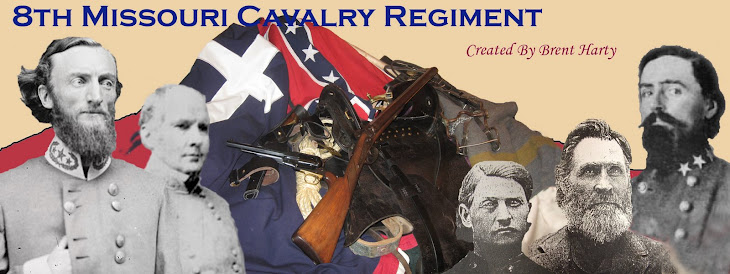
8th Missouri Cavalry Regiment


Saturday, July 18, 2009

Battle Analysis for Poison Spring

Here is a powerpoint presentation that I recently did for my Basic Officer Leaders Course III at Ft. Bliss, TX for Air Defense Artillery. It did not have to be an ADA battle, but the idea was to discuss pertinent effects of the battle and how they would apply to battle today. It had to be an a unit size that close enough to relate to what a 2LT would be expected to be able to control. So our instructor said we needed to study to a regiment size element of the battle or smaller. So I thought, what regiment do I know better than the 8th MO CAV REG?! So I focused on the 8th MO at the Battle of Poison Spring on 18 April 1864. They were a part of the charge of Missourians formed under COL Colton Greene that day who busted the center of the Federal lines. Once the Missouri CAV units of the 3rd, 4th, 7th and 8th MO (Co. B only of the 8th - the other companies were down in Louisiana with MG Kirby Smith) went in, the battle fully turned into a rout.

Well, here is my slide show...it tells the story well enough. But there are several bullet points later in the show where I simply talked on the point. So you'll have to do without my description of say, how agility was displayed during the battle from a leadership perspective. If you wish to know more, feel free to contact me and I'll go in more detail. I very much enjoyed going over the tactics of this battle as it is one of my favorite things to do...to discuss tactics and decisions made and 'what if' this decision would have been made', etc...